Urras’s propertarian social order
The DispossessedUrras’s propertarian social order is a society organized around private possession, money, wages, and profit, and it becomes the central political contrast through which Shevek tests what he has been taught about both Urras and Anarres. Its wealth is visible in its towns, farms, goods, and institutions; its inequalities are visible in the labor kept out of sight, the different claims people can make on resources, and the assumption that exchange must take the form of buying and selling. Shevek’s encounters with this order turn an abstract disagreement about economics into a practical question: whether people and knowledge can be shared without being owned or priced.
A society of ownership and exchange
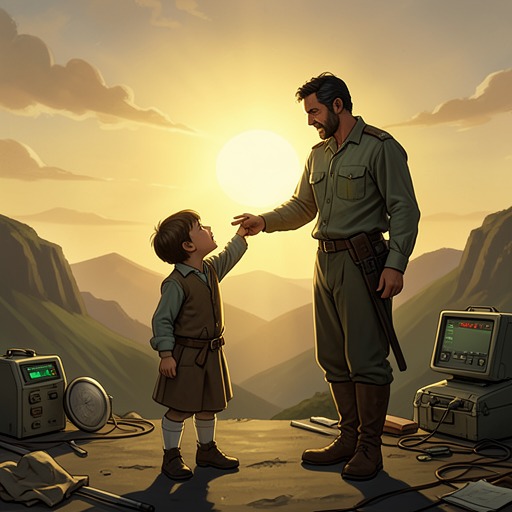
Shevek encounters Urrasti property relations first as a problem of survival. He arrives on the Mindful without money and with no meaningful supply of provisions to offer in exchange. Rather than pretend he can participate in a market, he explains that if Urras is to keep him alive, its people must give him what he needs. He calls himself the Beggarman, but the name also makes a point: an Anarresti accustomed to using and sharing goods can enter a money economy only as someone who must either be provided for or excluded. On arrival, he repeats the same principle to Atro and Pae, describing his empty hands as an Odonian way of coming among people. The contrast is not merely between having money and lacking it; it is between treating resources as commodities and treating another person’s needs as grounds for giving.
The institutions of Urras give that contrast a wider structure. In A-Io, educated people are said to get their news through telefax, radio, television, and weekly reviews, while printed newspapers are read mainly by lower-class audiences. Pae contrasts an openly available press, which he says produces much trash, with the absolute censorship of Thu, where the state determines what can be reported. The examples show different political arrangements, but neither makes public information independent of power: class shapes who reads which media in A-Io, while state authority controls publication in Thu. Shevek’s questions about unfamiliar newspapers take place inside a world where access to information, like access to goods, is socially organized.
The order is not presented as incapable of care or competence. During his visits through A-Io, Shevek sees prosperous villages, cultivated farmland, comfortable trains, and well-dressed, well-fed people who appear industrious rather than passively waiting for direction. He had expected that removing people’s spontaneous initiative and replacing it with external compulsion would make them careless workers. The visible quality of farms, vehicles, and public life forces him to reconsider: profit and its incentives can produce work with an effectiveness he had not expected. That revision does not settle the moral question. It establishes that the system can generate material abundance, while leaving open how that abundance is produced, allocated, and experienced by people in different positions.
Wealth, class, and labor out of sight
Shevek’s first sustained encounter with the market’s abundance is Saemtenevia Prospect, the long retail street in Nio Esseia. He had asked for Urrasti clothes and shoes because his Anarresti clothing made him conspicuous; the resulting trip overwhelms him with an array of objects and specialized outfits for different occasions. A fur coat in a shop window costs 8,400 units, although Shevek has read that a living wage is about 2,000 units a year. The numerical contrast makes the street’s display legible as more than abundance: some objects command prices far beyond an ordinary worker’s annual income. He is struck not only by the quantity of goods, but by the disconnect between the sellers and the people who made them. The workshops, farms, mines, and hands that produced the merchandise are somewhere else, hidden behind walls; in the shops, people meet things as buyers or sellers, joined to them through possession.
That separation unsettles Shevek because it makes the world of consumption appear detached from production. Once a tailor and shoemaker have taken his measurements, he can order what he needs by telephone, and he decides not to return to the street. The clothes suit him, but one shoe is made of animal hide, a material he has not expected to wear. In the mirror, the unfamiliar outfit also makes his resemblance to his mother, Rulag, more apparent. The scene joins market adaptation to a more intimate unease: he can put on the forms of the society around him without ceasing to be conscious of what they signify.
The distinction between buyers and producers also has a human cost in household life. At dinner with Oiie’s family, Shevek asks who does the dirty work in Urras, since he has not seen it being done, and whether those who do it receive better pay. Oiie answers that dangerous work sometimes pays more, but menial tasks pay less; people take them because low pay is better than no pay. He recalls his grandfather, who scrubbed floors and changed sheets in a hotel for fifty years, working ten hours a day, six days a week, so that his family could eat. His wife responds that Oiie’s father became a successful man who owned four companies. The exchange places the janitor’s labor and the family’s later prosperity in the same history, while revealing the discomfort of speaking about class at a table where a servant is present.
Urras’s prosperity is therefore not a simple answer to Anarresti criticism. Shevek can see industrious people and useful material achievement, yet he also sees labor divided by status and need. The society’s own arrangements make that division seem ordinary: a job is accepted because the alternative is not having wages, and a successful life can be measured by ownership. In this context, the gap between those who consume and those whose work remains out of sight is part of the organization of property, not an accidental blemish on an otherwise shared prosperity.
Money, value, and the limits of Shevek’s bargain
As Shevek works in A-Io, payment attaches itself to his scientific activity. He receives the 10,000 International Monetary Units of the Seo Oen award, a 5,000-unit grant from the Ioti Government, a professor’s salary, and money from the University Press for three monographs. What first seems amusing becomes disturbing. He cannot make sense of elementary economics or the operations of banks, which seem to him elaborate and unnecessary, yet he recognizes that money is of tremendous importance in the world he has entered. He is frightened by its power even as he dismisses the assumptions that sustain it: that greed, laziness, and envy govern human action.
The marketplace’s power over value appears again when Shevek visits an art gallery in Nio Esseia. A painting has a price tag of 4,000 IMU; the attendant identifies it as a Feite and describes it as a promising investment. Shevek points out that the sum would keep two families alive for a year in the city. The attendant’s reply—that it is a work of art—does not answer the social comparison. Art exists simultaneously as an object to be looked at and as an asset to be bought, sold, and expected to increase in value. Shevek’s unease is sharpened by the thought that even ordinary politeness may be bound to a purchase: after buying postcards and a map, he wonders whether the shopkeeper’s courtesy came with the transaction.
This is why Chifoilisk’s warning about the profit economy does not simply persuade Shevek to reject his mission. Shevek answers that he came to bargain with it. His objective is to bring his people out of exile, to reopen exchange between Urras and Anarres, and to bring down the walls between them. He believes the rulers of A-Io may fear him less than Thu does, not because A-Io is free of power, but because its people have forgotten the revolution and believe possession can make people content in a kind of prison. Shevek’s plan uses a society whose assumptions he distrusts in order to seek a relation it has not chosen: solidarity across worlds.
The economics of Urras also meet Shevek’s experience of Anarres during the drought. When a train carrying 450 people is stranded for twenty hours in a mill town of 160, the town has no reserve large enough to feed the travelers without risking its own survival. It gives them nothing. Shevek and the other passengers go without food for sixty hours, and he confronts hunger as a condition he had never previously imagined: meals had always been available, even when he sometimes chose to miss them while working. The episode makes scarcity a test of sharing rather than an abstraction. He considers how fear and force might enter when there is not enough, and how people may protect what they call theirs by turning away from others. When the train finally reaches a stocked station and the passengers share bread and soup, their relief and renewed joking show that solidarity can survive deprivation, but is not guaranteed by good intentions alone.
Property, political power, and public gifts
The political scale of property is clearest in the relation between Urras and Anarres. Urrasti freighters arrive only eight times a year, bringing fossil fuels, petroleum products, specialized machine parts, electronic components, and experimental plant strains; they carry away metals and other ores. The trade is profitable for Urras, and the division of cargoes is a major event in its Council of World Governments and stock market. Anarres is nominally a free world, yet the arrangement makes it a mining colony in practice. Anarresti protests recur in debates at Abbenay, but the counterargument is that mining the ores themselves would cost Urras more than purchasing them, while ending the agreement could invite invasion. The marketplace’s calculation thus becomes a deterrent to military force, without creating trust: seven generations of peace have not removed the fear beneath the bargain.
Shevek’s alternative is not simply to denounce exchange, but to distinguish a gift from a sale. Near the end of his journey on Urras, he asks whether there is any alternative to selling and whether a gift can exist. He wants to give his theory to Keng, Hain, and the countries of Urras so that no one society can use it to dominate others, enrich itself, or win wars. In this proposal, scientific knowledge is not a private asset whose value depends on exclusive possession. It is to become available to all, for common use. Keng suggests that truth will ultimately serve the common good; Shevek refuses to wait for that eventuality, insisting that his lifetime must not be spent serving greed, profiteering, or any master.
The order’s significance in the novel lies in the way it makes ownership more than a legal relation. Property shapes which needs are met, what work is visible, what objects mean, and how knowledge can be controlled. Urras shows Shevek that profit can motivate productive work and coexist with conspicuous prosperity; it also shows him that wages can make a person accept low-paid labor, that wealth can turn art into investment, and that trade can bind one world to another through unequal dependence. Against these arrangements, his insistence on giving his theory becomes a political act: he offers knowledge as a shared resource and tests whether exchange can connect people without making one party the owner of the other’s future.